
Fungal Misadventures
Searching for mushrooms in the desert Southwest

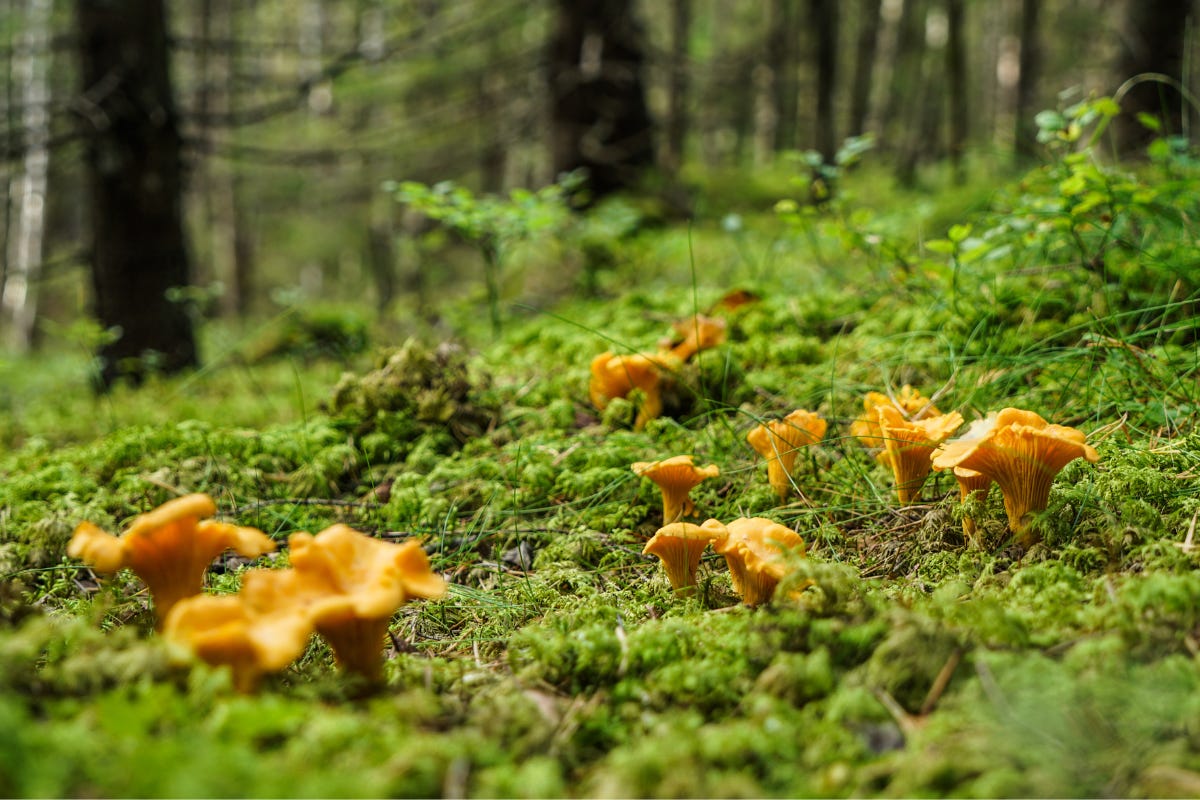
The Mushroom Hunters: On the Trail of an Underground America profiles the gourmet mushroom foraging industry in the U.S. from its epicenter in the waterlogged Pacific Northwest. Langdon Cook, a writer and wild foods educator, penetrates this secret world with the help of some uncharacteristically trusting mushroom hunters and dealers. These nomadic individuals let him follow in their footsteps as they try to make a living off the ephemeral, fastidious fruiting bodies that human agriculture has never tamed and perhaps never will.
The vibrant characters in Cook’s narrative are professionals, with encyclopedic knowledge of the ecology, topography, and microclimate of their chosen hunting grounds, learned through decades of experience. Their fine-tuned craft pushes beyond the realm of science into the domain of fine art. They know the individual trees, ravines, and hillsides that produce the mushrooms they’re searching for and exactly when. Following the rain, these itinerants live by the mushroom calendar — morels in early spring, boletes and chanterelles in late summer, oysters and matsuke in the fall, black trumpets and hedgehogs in the winter.
Though they may harbor a personal fondness for mushrooms, the professional hunters Cook profiles are ultimately motivated by the economy of wild fungi, their status as precious commodities. If you’ve ever shopped somewhere that offers a selection of mushrooms beyond the garden variety button mushrooms (Agaricus bisporus), you’ll know that they often come at a staggering price. Wild mushrooms moreover are so perishable, with just days or even hours between when they are picked and when they much be consumed, that the supply chain must move rapidly, relying on a network of hard-working, savvy pickers.
The damp, dark old-growth forests of the mountainous PNW are hallowed grounds for mushroom hunting in North America. Cook’s descriptions of days spent harvesting more than 100 pounds of chanterelles, or bucketloads of chunky king boletes, or a truckload of morels, are simply unfathomable to me as an Arizona mycophile. I dream of finding such flushes, literally.
The world of professional mushroom hunters, as Cook paints it, is not full of the hippies and yuppies who enjoy a weekend foray. These are gruff, working class people, many of them immigrants from Southeast Asian, with a Wild West mentality — highly territorial with their patches and willing to take high risks for the possibility of high reward. Cook follows hunters as they violate federal laws in protected areas and trespass on private property in search of unfathomably large flushes.
On the other end of the mushroom hunting spectrum, you have me, for whom mushroom hunting is largely a theoretical hobby, involving going out on trails or in my backyard and looking randomly at logs and trees, hoping to glimpse something ephemeral and remarkable. At my childhood home in Kentucky, my mother and I have taken many a saunter through the woods with mushrooms on our minds, usually to find absolutely nothing. But a walk in the woods never feels like a waste, as long as your livelihood does not rely on what you find. If I see even one single fruiting body, it genuinely makes my day.
The joy of mushroom hunting for me is in the encounter, in seeing the surprising and improbable places mushrooms emerge from, their staggering variety of forms, their elusive nature, the questions they prompt. Mushrooms are a gift from the Earth like no other – we do nothing at all to deserve them, we hardly understand what causes them to flourish or to flounder, and we have largely failed in our attempts to domesticate them and grow them through the force of our will. We have to go out there into the woods, be attentive, and get our hands dirty to find them, just like our hunter-gatherer ancestors of many millennia ago.
Arizona is admittedly not the ideal place to fall in love with mushrooms. For much of the year, it’s lip-chappingly arid, scorchingly hot, blazingly sunny – generally speaking, mushrooms prefer the opposite conditions. This past summer, which was supposed to be monsoon season and by extension mushroom season, was uncharacteristically dry, in an already drought-ridden state.
And yet. When you keep an eye out, you find them anyways, under the most improbable conditions. Mushrooms and the people who love them are absolutely everywhere. Arizona is not the uniform desert wasteland you may imagine it to be if you don’t live here — it contains the largest contiguous ponderosa pine forest in the country, and mixed conifer forests in the San Francisco Peaks, the Sky Islands, and many more mountain ranges, the perfect conditions for mushroom hunting if you know where to look and when.
Even without knowing where to look or when, I have found many mushrooms in the Prescott area this year that have brought me much joy, even when it was just one, even when they were all dried up and barely identifiable. Here are a few of my favorite fungal finds from late summer and early fall in the Grand Canyon State.
Inocutis dryophila
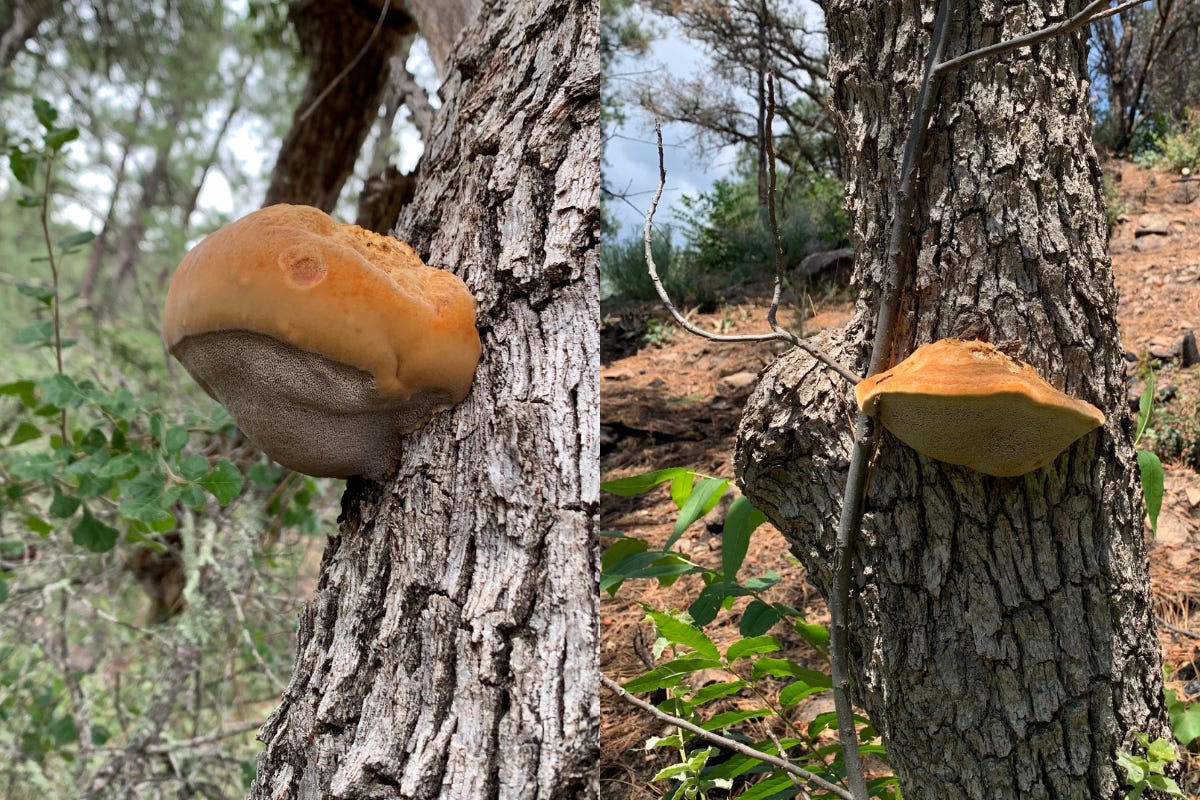
As soon as I began looking for fungi on every hike in late summer, I noticed these large, mysterious orange blobs everywhere, always growing on living oaks. Though this fungus is exceedingly common in Prescott, there is very little information about it anywhere online — I only learned what it was thanks to the help of citizen mycologists on iNaturalist, where I post my observations. Its entire Wikipedia page reads: “Inocutis dryophila is a plant pathogen.” So it’s probably not a great thing for these oak trees, but it was always a welcome sight in my search for fungi.
Spring Polypore (Lentinus arcularius)
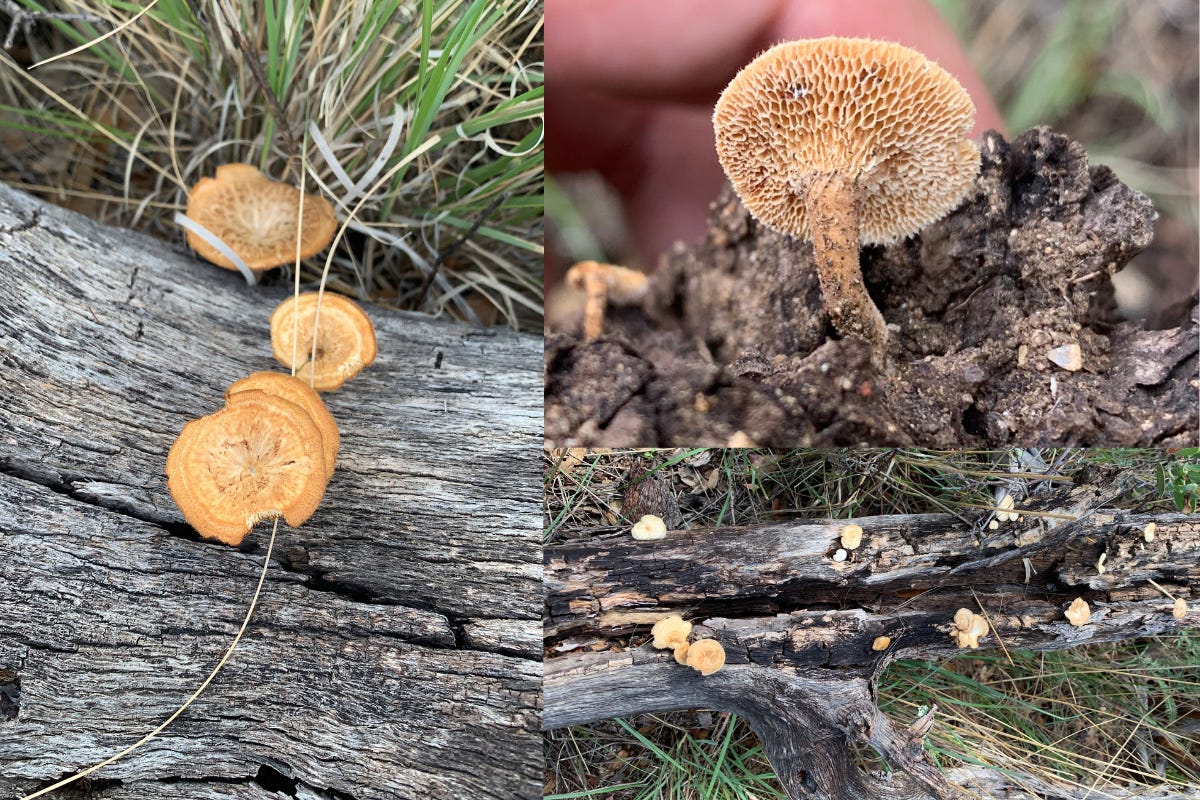
These little spring polypores are an extremely common sight on fallen logs, particularly on oaks, in the summer and fall. They are gifted agents of white rot, meaning they can break down lignin, a polymer in wood that is particularly complex and difficult to decompose. Polypores are named for the pores they have on their undersides rather than gills to disperse their spores — turkey tail, reishi, and chicken-of-the-woods are some of the more glamorous polypores.
Lobster mushrooms (Hypomyces lactifluorum)
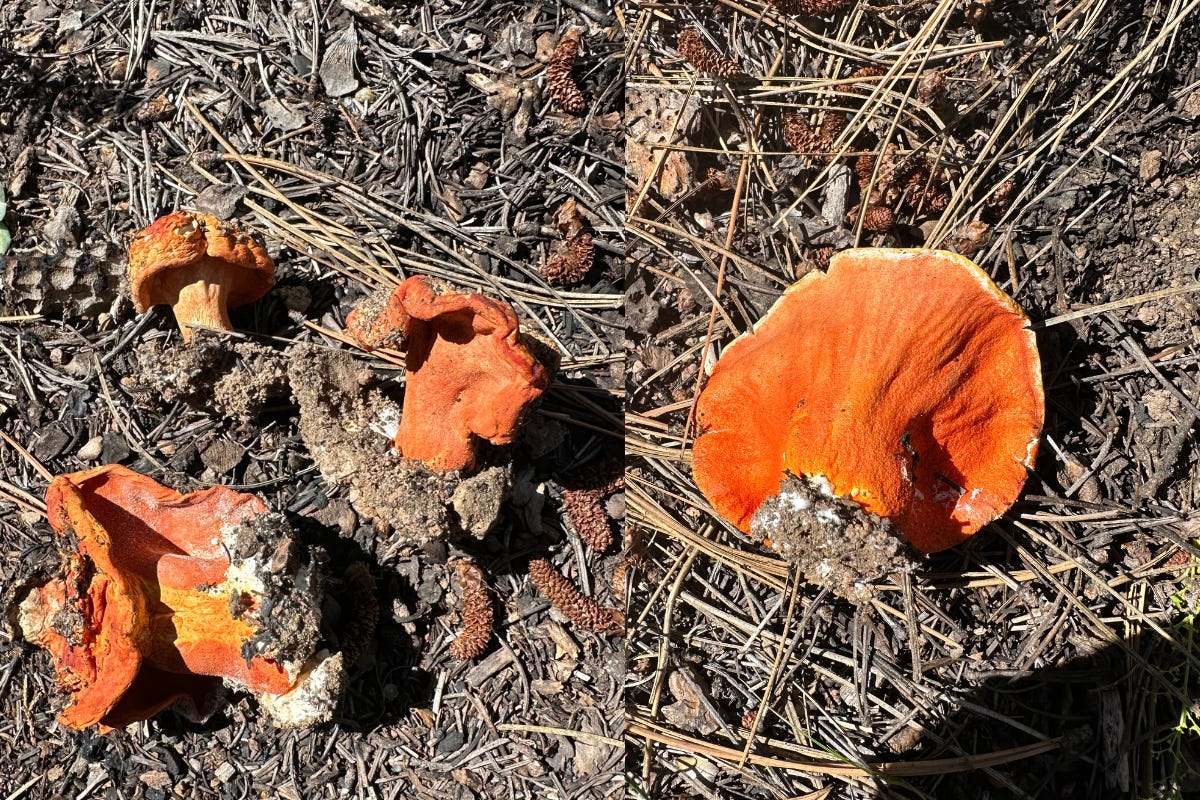
Lobster mushrooms are a composite organism — the orange outer layer is Hypomyces lactifluorum, a parasitic fungus that grows on the surface of certain varieties of white mushrooms, transforming them from bitter and inedible into delicacies prized for their seafood flavor. If these hadn’t been baking in the sun for a few days, they would have been a choice edible.
Artist’s conk (Ganoderma applanatum)
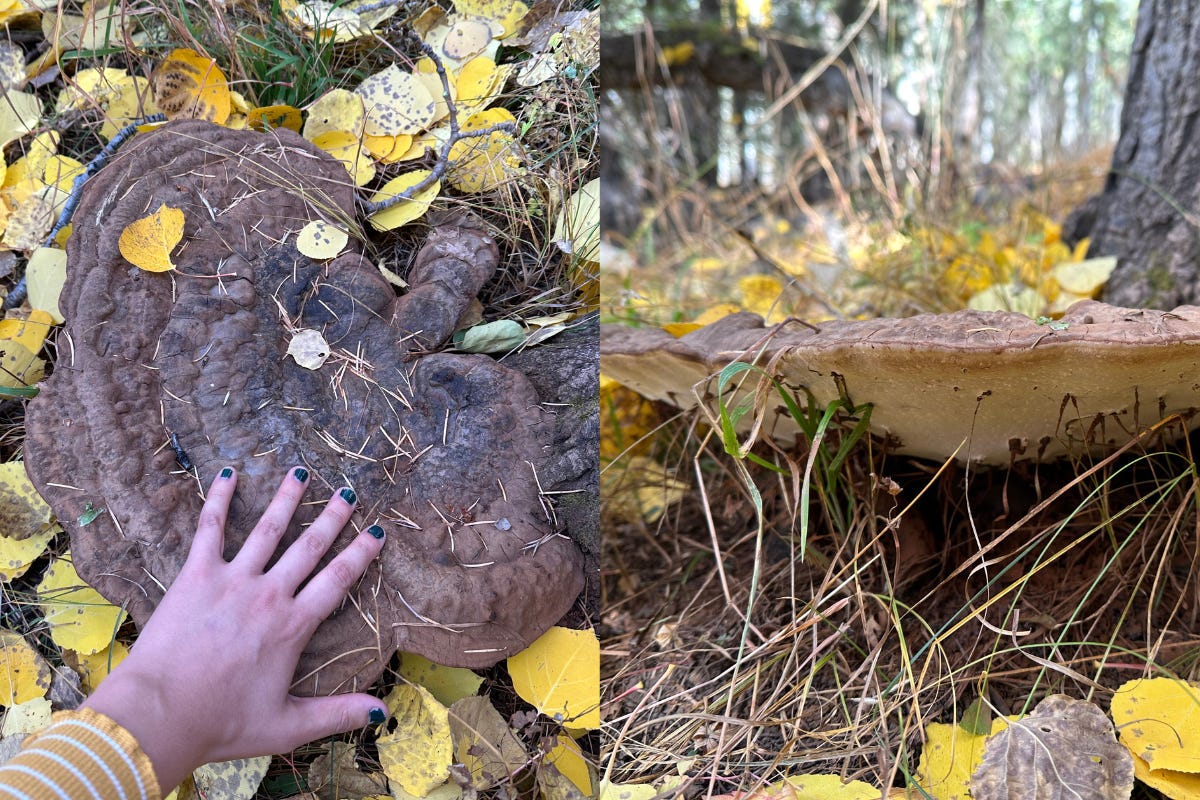
By far my biggest fungal find of the year! This was the largest of many specimens I saw one afternoon among the aspens in the San Francisco Peaks. They’re parasitic — every one I observed was growing along the base of a dead or dying aspen. This fungus is nicknamed artist’s conk because it can serve as an artistic medium — the white spore surface on the under side can be carved with a sharp implement and dried out to preserve the image. Artist’s conk is in the same genus as reishi mushrooms (Ganoderma lingzhi) — both are widely used in traditional Chinese medicine. They are inedible, but can be made into teas and tinctures, and recent research has indicated they have anti-tumor, anti-viral, and anti-biotic properties.
Slippery jacks (Suillus sp.)
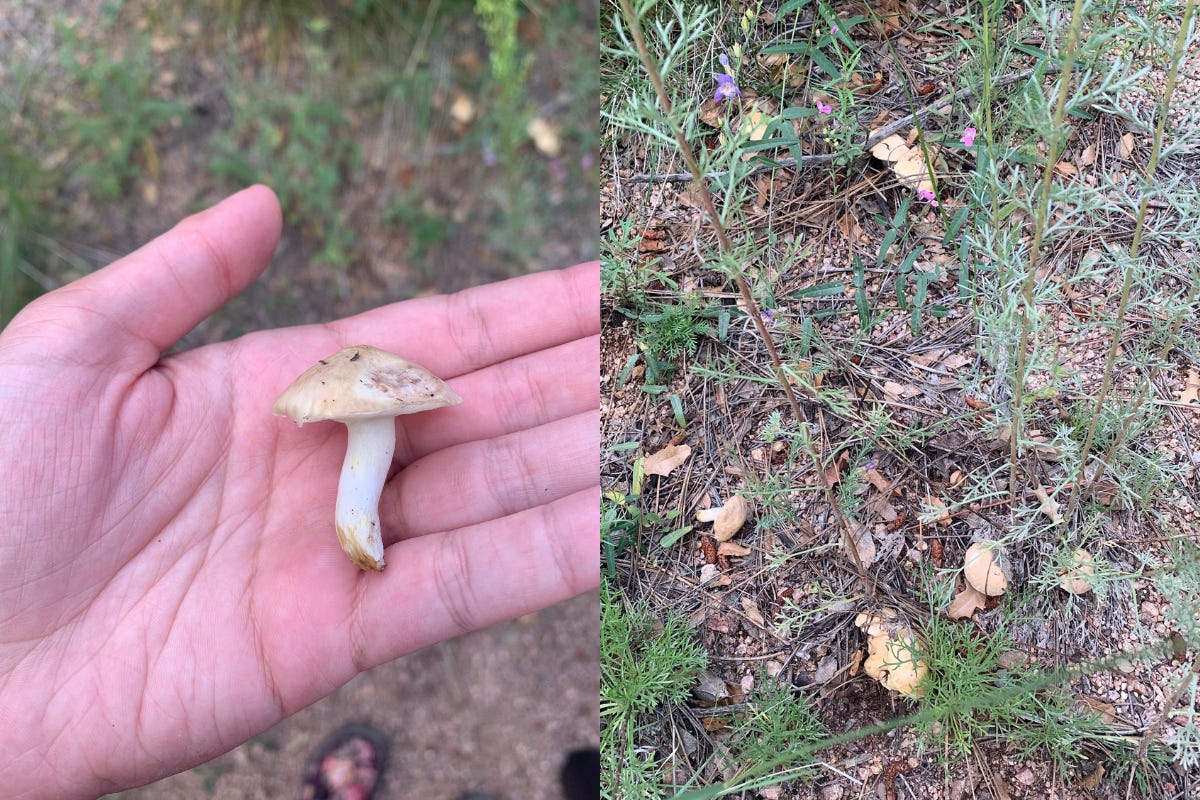
This is the flush that still haunts me. From above, these dirty light brown caps are almost indistinguishable from dead leaves, and their stalks were well hidden beneath the dirt and pine litter. I still don’t know how I spotted these — this is why I’m always staring at leaf piles like a maniac. I look at these photos and wonder about all the flushes I’ve certainly walked right past unseeing, knowing now how inconspicuous they can be…
Slippery Jacks are boletes, an order which contains many prized edible mushrooms including porcini. A local mushroom guru on iNaturalist told me this species is Suillus occidentalis, which grows in association with Ponderosa pines and has no Wikipedia page. It could very well be delicious, but I wouldn’t risk it.
Puffballs
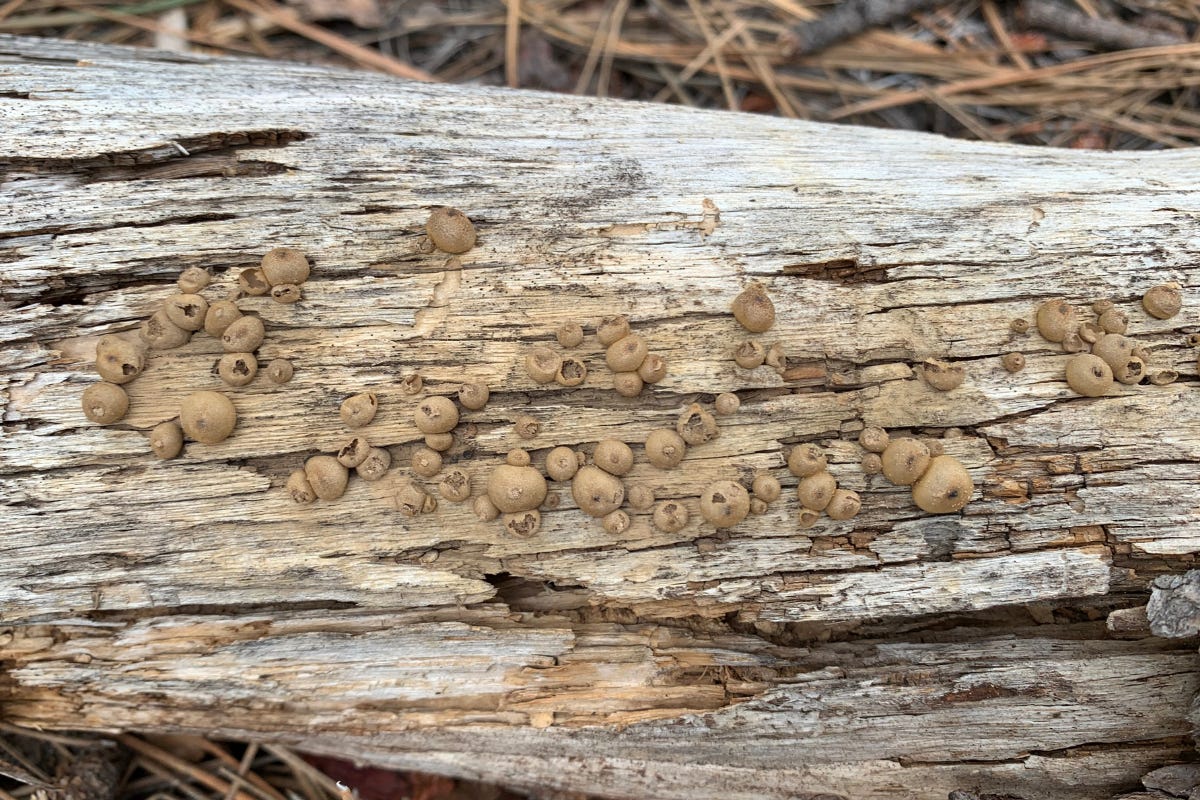
I have yet to find fresh puffballs, which are all white inside and a choice edible. I have yet to find giant puffballs, which can grow several feet in diameter and weigh many pounds. But I have found many little old brown puffballs on fallen pine trees, which shoot out dense clouds of spores when poked. I enjoy helping them proliferate by giving them a generous beatdown.
Barometer earthstars (Astraeus hygrometricus)
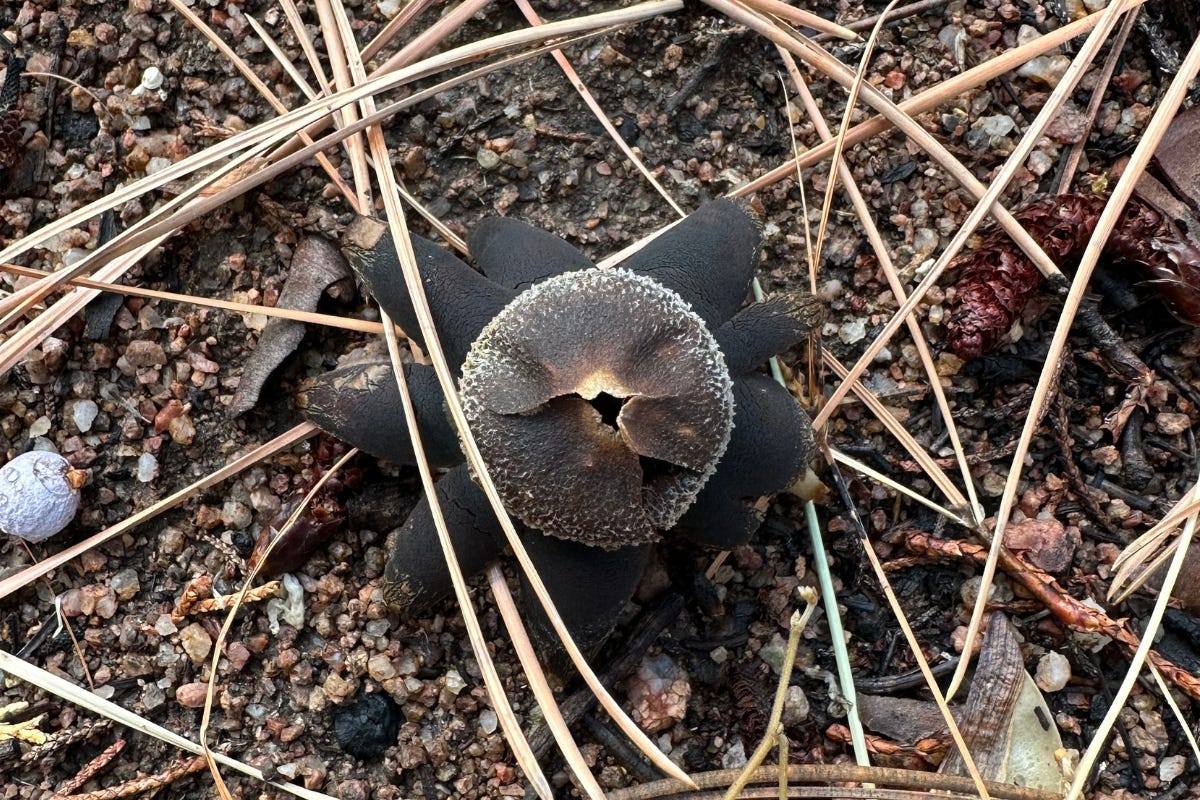
These earthstars are perhaps the fungus I have seen the most since moving to Prescott, and it boggled my mind when I first learned that these are mushrooms. They just lay on the forest floor, not attached to anything! Where do they come from? How do they grow??
What I’ve learned is that barometer or hygroscopic earthstars begin growing embedded in soil, curled up in a ball. When there is just enough moisture in the air and the conditions are optimal for spore dispersal, they unfurl into a star shape, pushing themselves out of the ground, revealing a puffball-like interior containing their spores. Little fungal stars emerging from the earth when it rains — how magical and delightful!
Agaricus sp.
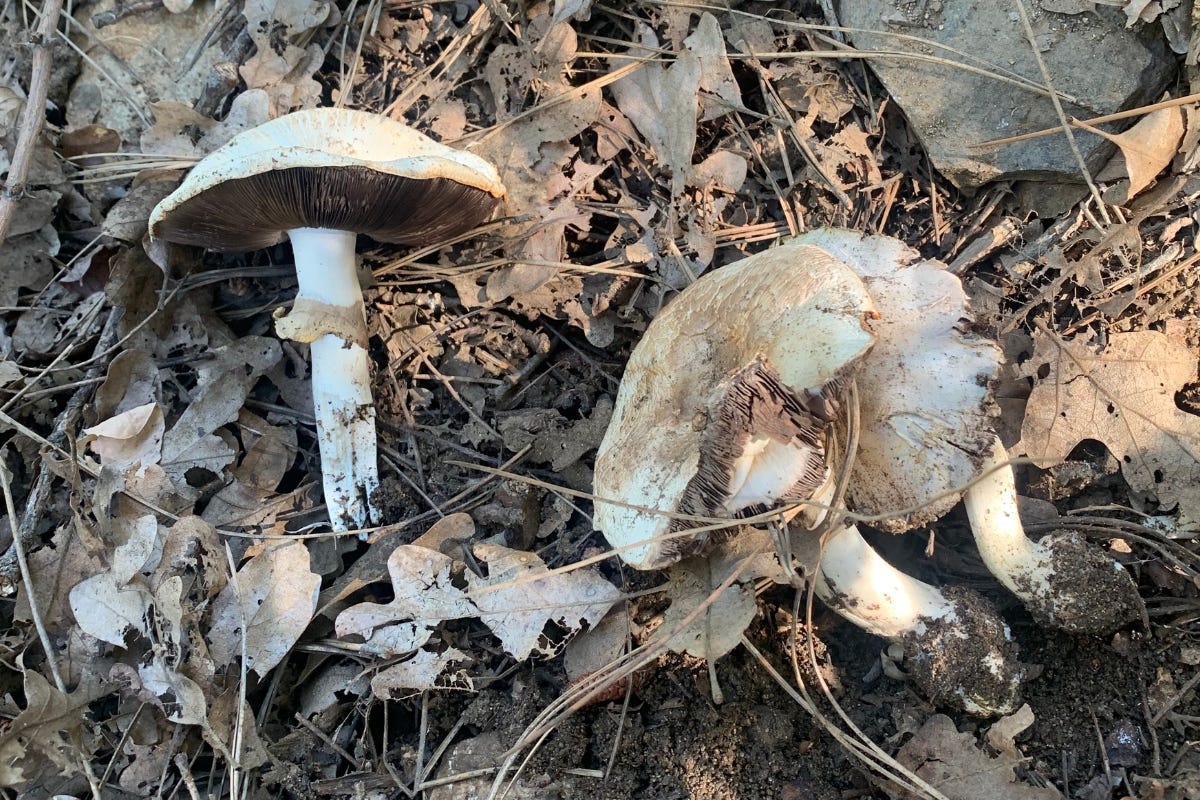
These white agarics with their brown gills are likely in the same genus as Agaricus bisporus, your standard supermarket mushroom. On the mushroom on the left, you can see a light brown flap of flesh towards the middle of its stalk — that’s a remanent of the partial veil which covered its stalk and gills before it matured.
Amanita sp.
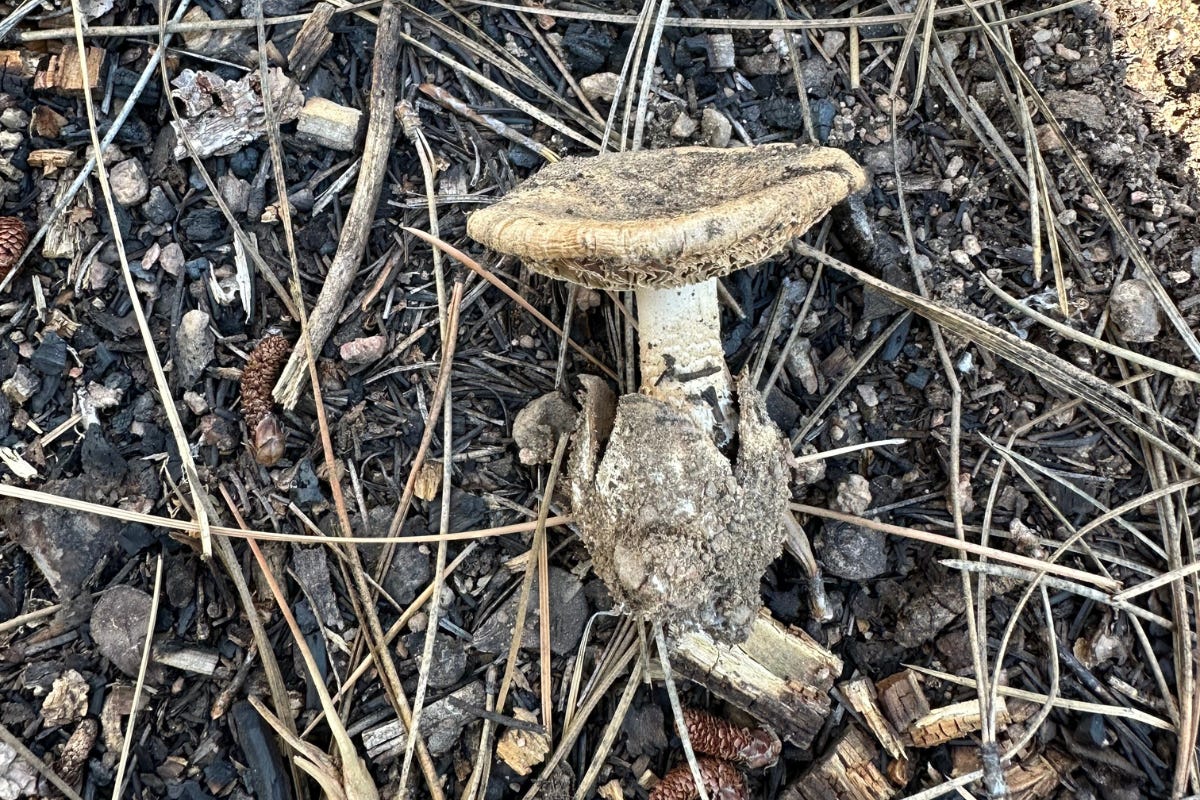
Speaking of veils, I was so happy to find this little Amanita despite its desiccated state, because you can perfectly see the egg-like structure at its base from which it emerged. This egg is known as a universal veil, and it covers the entire mushroom body before it matures. The presence of a universal veil is a pretty good sign that your mushroom is an Amanita, the genus which is responsible for 95% of fatal mushroom poisonings. This little guy very well could be deadly.
Shaggy Mane (Coprinus comatus)
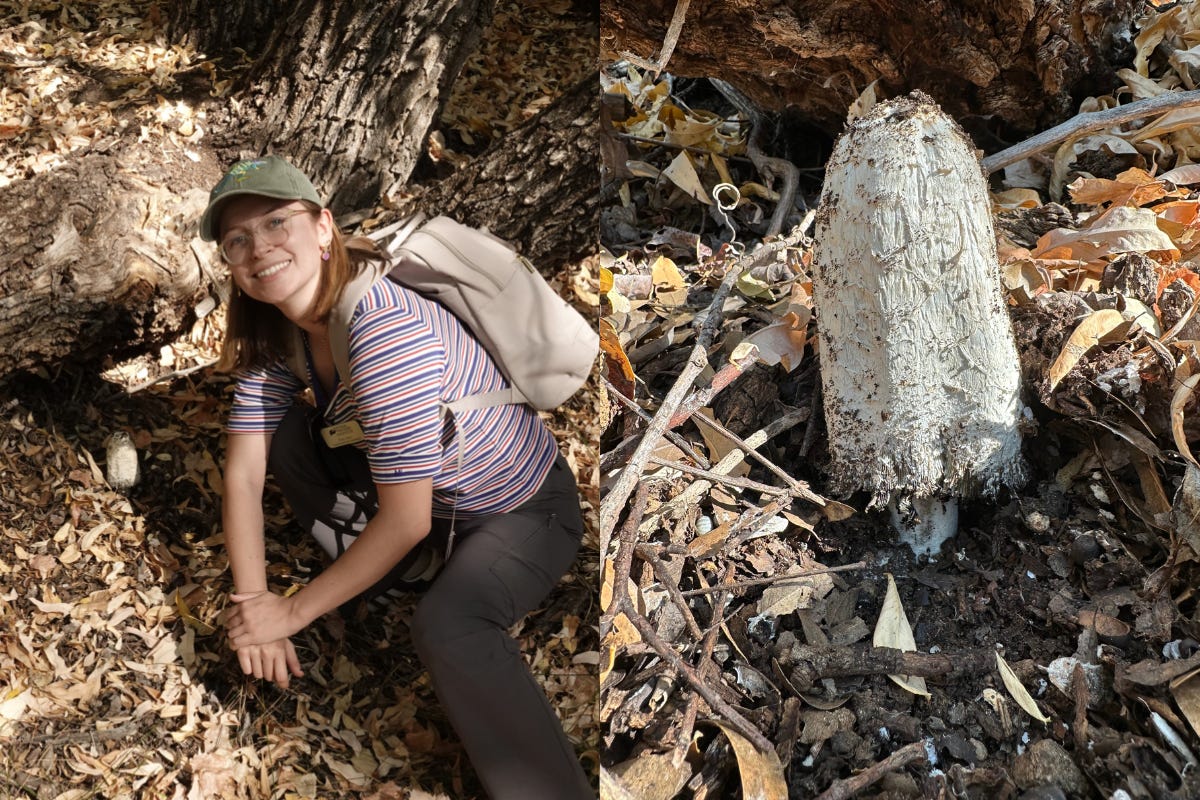
Saving the best for last. This is my favorite mushroom specimen I’ve seen to date in Prescott, and I stumbled upon it at the perfect time. Coprinus mushrooms are inky caps — they have very tightly packed gills, so they’ve evolved the ability to self-digest from the bottom of the cap up. This causes their caps to curl up, exposing their gills which quickly dissolve into a thick black goo. Here is an excellent time lapse video of their deliquescence. Older inky caps just look like a flat blackened disk on the end of a long, thin stalk. I was so happy to find this fresh one just as its gills were just beginning to liquify, and very fortunate that my naturalist and photographer friend Walt Anderson was there to capture a photo of my mushroom joy.
Thank you for attending my virtual fungal show-and-tell. These are not the kind of visually striking fungi finds that will gain me many Instagram followers. I will not yet be quitting my day job to become a full-time mushroom influencer. But I have learned so much just by trying to identify what I’ve found, and every encounter is a little story I cherish. I hope you’ve learned something too that will inspire you to keep your eyes a little more peeled for our fungal friends.
In these dormant winter months, with the help of books like Mushrooms Demystified, I’m striving to learn all I can about where Arizona wild mushrooms fruit and when, so I can make the most of the 2024 season. I can’t wait for the snowmelt of the spring and morel flushes that follow.
This is all really cool. It's striking how there's both edible and potentially poisonous mushrooms all over, even in the AZ desert. Did you need multiple runs through a book on mushrooms to identify them? Or is there some digital tool or general guide to know the name of whatever I'm looking at as I see something sprouting out of my neighborhood trees and soil?